
What is dry needling? Firstly we need to know what a trigger point is.
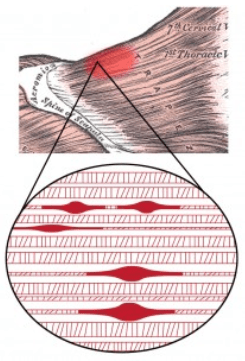
All skeletal muscles are made up of muscle fibres which are muscle cells connected end to end, they contract and relax constantly in all that we do in our daily lives when we are working, exercising and even relaxing watching TV. Our muscles are always working against the forces of gravity even when we are sat down. With all this work some of the muscle fibres get stuck in a contracted state, so the muscle fibres around them work harder and in turn, they eventually stay contracted. This cycle carries on until feel a tightness in the muscle or you may feel other symptoms in nearby areas such as headaches or toothache it’s all dependent on the location of the muscle. They can also be caused by injury, not the injury itself but the body compensating for the pain, if one leg is injured and causes a limp, it is not natural for other muscles to work harder and reduce the pain from the injury.
This image shows how the trigger point is made up, see the muscle fibres begin to stay in the contracted state. Trigger points can be treated by therapists in a number of ways and dry needling is one of them.
Dry needling or ‘myofascial trigger point dry needling’, a similar technique to acupuncture is sometimes also known as intramuscular stimulation. It involves the use of single-use needles for therapy of muscle pain, including pain related to myofascial pain syndrome. Dry needling is mainly used to treat myofascial trigger points, but it is also used to target connective tissue, neural (nerve) ailments, and muscular ailments.
Dry needling is different from acupuncture in that it is only treating skeletal muscle and connective tissue pain and dysfunction.
The American Academy of Orthopaedic Manual Physical Therapists (AAOMPT) states:
Dry needling is a neurophysiological evidence-based treatment technique that requires effective manual assessment of the neuromuscular system. Physical therapists are well-trained to utilize dry needling in conjunction with manual physical therapy interventions. Research supports that dry needling improves pain control, reduces muscle tension, normalizes biochemical and electrical dysfunction of motor end plates, and facilitates an accelerated return to active rehabilitation.
So how does sticking a needle into an area of muscular pain work?
A needle which can vary in length from 13mm to 90mm, a number of needles are placed in the muscle and manipulated to illicit a local twitch response. The insertion of the needle into the muscle can reactivate the muscle fibres at a neuromuscular level allowing them to lengthen and helping to reduce pain. After leaving the needles in for a short period of time they are removed, there can be some bruising or bleeding
Acupuncture differs by treating the body’s Chi energy and keeping the balance of Yin and Yang using needles in the hundreds of acupuncture points around the body for treating a number of ailments and conditions such as stress, IBS, migraines, arthritis and back pain just to name a few.